mGuarder
EU AI Act compliance you can defend: deterministic, auditable, reproducible.
No credit card required
The regulation is in force.
Your evidence isn't.
The EU AI Act is in force. Providers and deployers must classify every AI system by risk, identify their role, and evidence their obligations. Penalties reach €35M or 7% of global turnover. High-risk obligations apply from 2 December 2027, and customers, procurement teams and regulators are already asking for proof.
Yet most teams still manage classification in spreadsheets, or ask an LLM chatbot whose answers can't be reproduced or audited.
- Manually mapped to the regulation, error-prone at scale
- No versioning: nobody can prove what changed or when
- Nothing an auditor can independently verify
- Same question can produce a different answer next time
- Rarely cites the specific AI Act article behind its answer
- No audit trail to hand to a regulator or customer
- Same inputs always produce the same, versioned result
- Every outcome cites the exact AI Act article that triggered it
- Exportable evidence trail, built for auditors from day one
Five tools, one workflow.
Everything a compliance officer needs to classify, track and evidence AI Act obligations, without reading 100 pages of regulation.
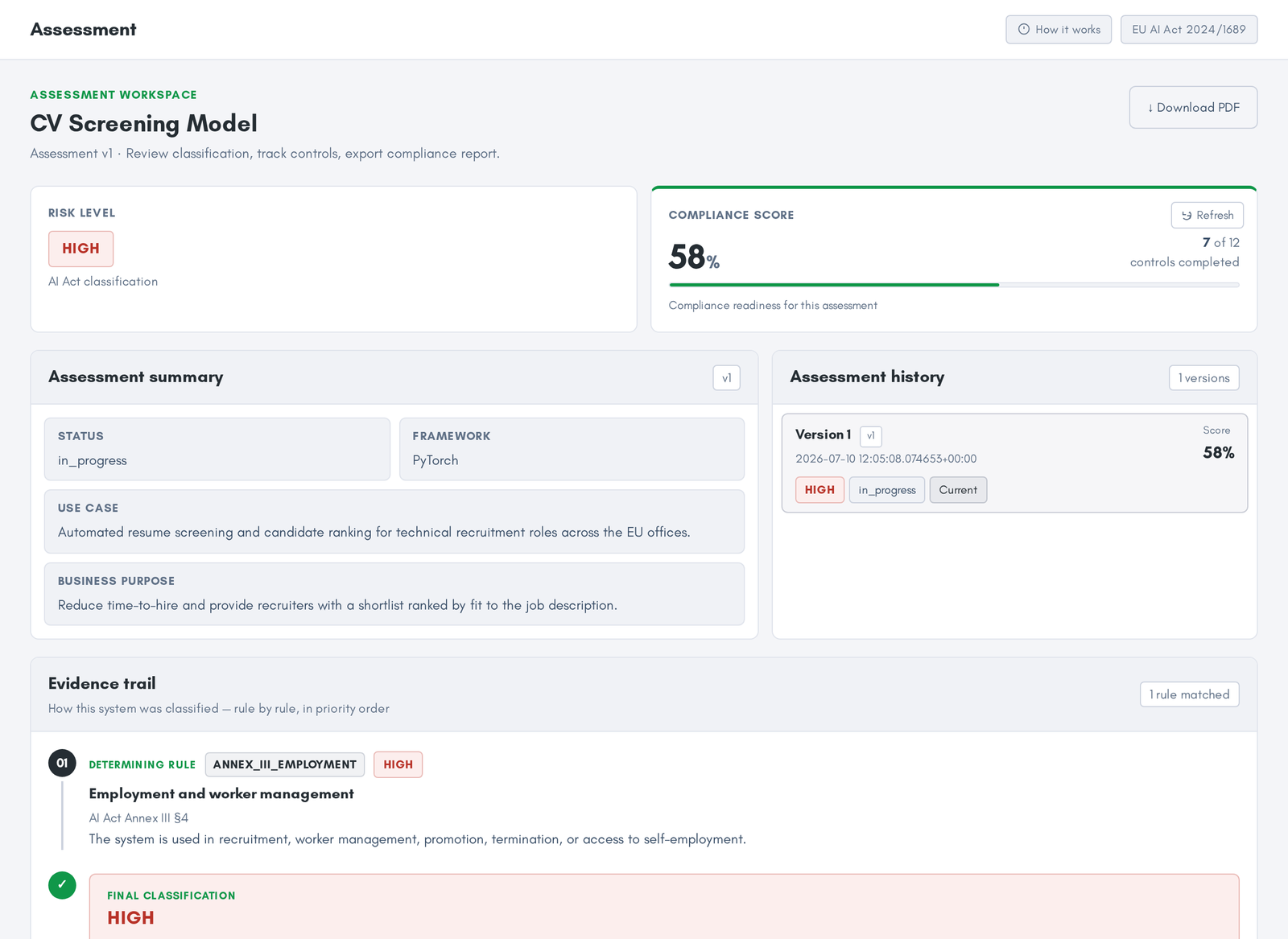
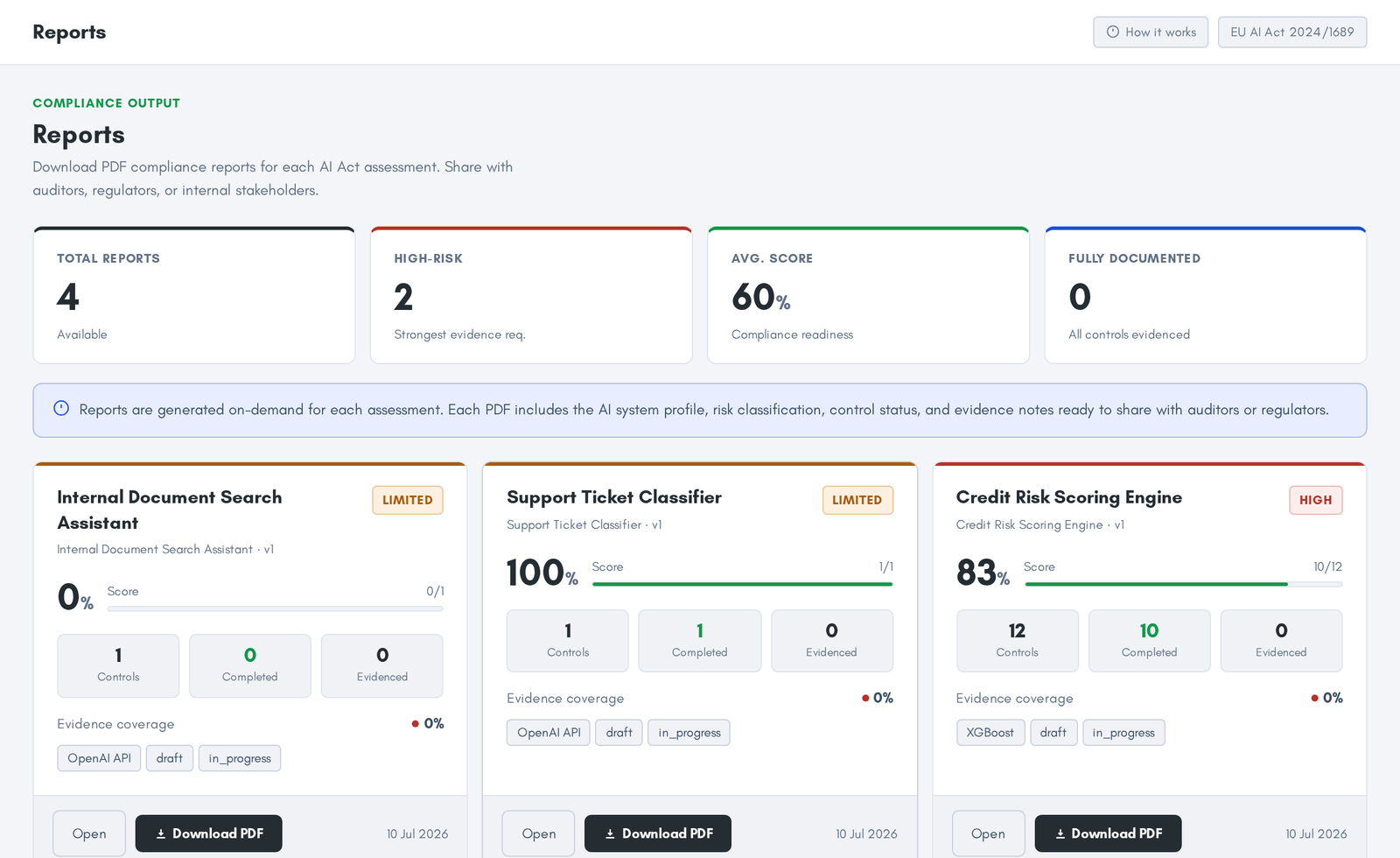
mGuarder is built by engineers from the safety-critical software world (ISO 26262, DO-178C), where every decision must be traceable and reproducible. We apply the same discipline to AI Act compliance: a rule engine you can inspect, not a probabilistic model you have to trust.
Built for the people accountable
for the answer.
Compliance officers, DPOs, AI-governance leads and consultancies at SMEs and mid-market companies that build or deploy AI systems in the EU.
Questions worth
asking upfront.
Does the EU AI Act apply to my company?
If you build, deploy, or use an AI system that affects people in the EU, in most cases yes. The Act applies to providers and deployers, not just AI vendors. mGuarder's classifier walks you through the actual criteria, prohibited practices, Annex III high-risk categories, Article 6(3) exceptions, GPAI/transparency duties, so you get a specific answer for your system rather than a generic guess.
How is this different from hiring a compliance consultant?
A consultant interprets the regulation for you, on their schedule, for their fee. mGuarder is a self-serve rule engine you run yourself: describe your use case, get the classification and the exact article behind it in minutes, and re-run it whenever your system changes. Most teams use both. We replace the repetitive first-pass work, not legal judgement on genuinely ambiguous cases.
How is this different from asking an AI chatbot?
A chatbot's answer to the same question can vary between two runs, and it may not tell you which clause it based the answer on. mGuarder's classification is a deterministic rule engine: the same inputs always produce the same output, and every result links to the specific AI Act article that triggered it.
Does mGuarder replace legal advice?
No. mGuarder gives you a structured, evidenced first assessment of your obligations under the AI Act. For genuinely ambiguous or high-stakes cases, we recommend having your legal team review the classification, the same way you would review any compliance tooling output.
What if my system turns out to be minimal or no risk?
You still get a documented classification with the article-level reasoning behind it, useful for internal records and future audits. Minimal-risk systems have the fewest obligations, but "no obligations" and "no proof" are different things when a customer or regulator asks.
What happens after the 15-day trial?
Early access includes a 15-day free trial with no credit card required. We're in early access and working directly with the first teams on board to shape what ships next, with no minimum commitment during this period.